Start with a design idea
Before you cut anything, study your tree from all sides and decide on a front — the viewing angle that shows the best trunk movement and root spread (nebari). Sketch a rough shape or take a reference photo. A clear idea keeps you from removing branches you will later wish you had kept.
Work with the tree’s natural habit
Follow the growth direction the tree already wants. Junipers and pines suit cascading and informal upright styles; elms and maples adapt well to broom or informal upright. Forcing a species into an unnatural silhouette is a long, frustrating fight. Let the trunk’s existing movement guide the design.
Structural pruning first
Remove dead wood, then branches that grow straight down from the underside of limbs, those that cross or rub, and any pointing directly back toward the trunk. Keep enough foliage to sustain the tree. On conifers, never cut a branch back to bare, needle-less wood — it will not regrow. Step back often and review the whole tree, not just the branch in front of you.
Wire to set direction and movement
Choose wire gauge that holds the branch without crushing it — roughly one-third the branch’s thickness. Anchor the wire in the soil or a stable lower branch and wrap at an even angle, then bend gently. Wire sets curves and angles you cannot achieve by pruning alone. Apply it to one branch at a time, working from the trunk outward.
Maintain and refine over time
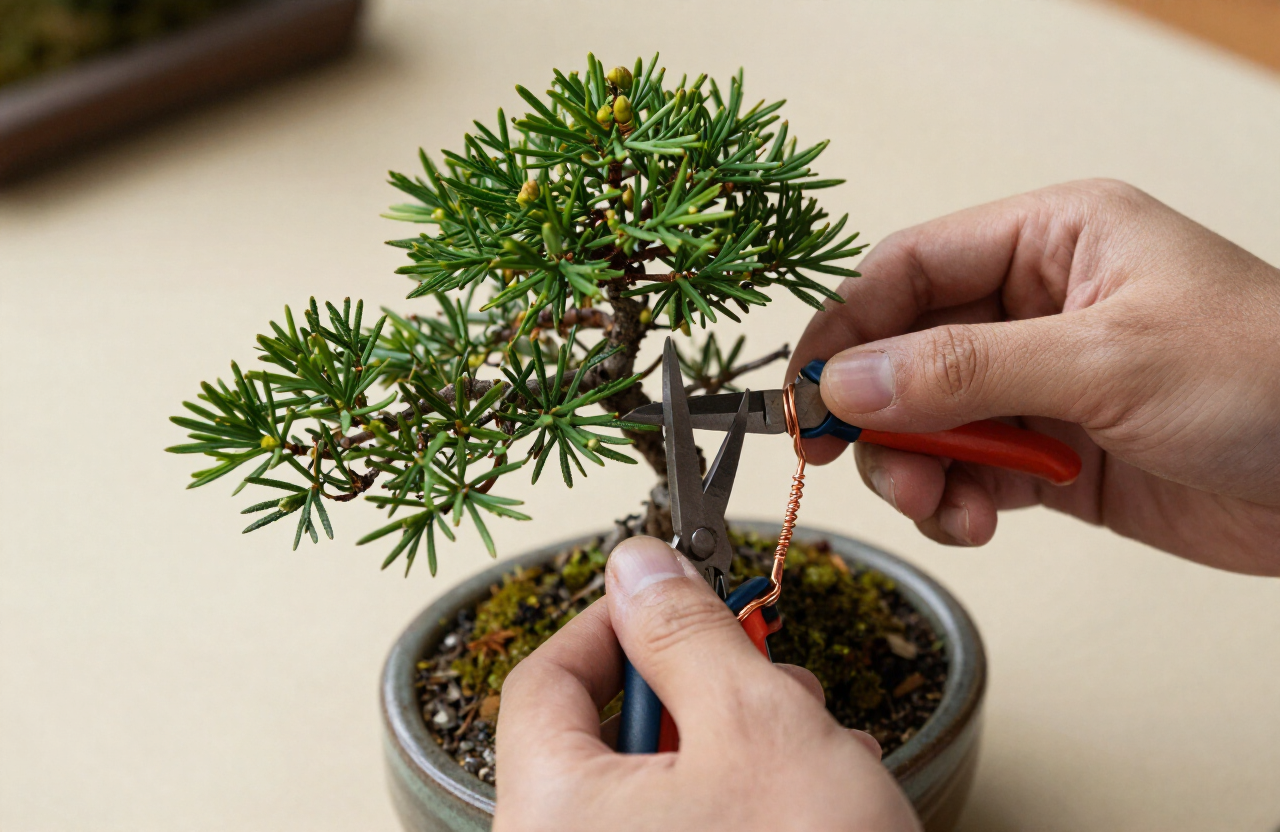
Check wired branches every few weeks; remove the wire before it bites into the bark as the branch thickens — cut it off in short pieces rather than unwinding. Maintenance pruning pinches back new growth to keep the silhouette dense and lets light reach inner branches. True refinement happens over seasons, not a single afternoon.
A common mistake to avoid
Wiring every branch at once and leaving the wire on too long. As branches thicken, wire cuts into the bark and leaves permanent scars — check often and remove early.
Every tree and growing environment is different. For major work or a declining tree, get species-specific advice from a local bonsai club or nursery.
KEEP LEARNINGCaring for your bonsai while you travel